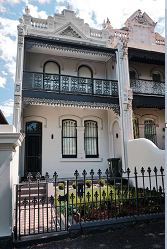
I’ve seen it too many times.
A small crack in plaster becomes water ingress.
Water ingress becomes timber rot.
Timber rot becomes a five-figure structural repair.
And the owner always says the same thing:
“We were going to fix that.”
Here’s the uncomfortable truth about heritage homes in Melbourne:
Neglect compounds faster than value.
The Slow Leak That Becomes a Landslide
Most heritage deterioration doesn’t happen dramatically.
It happens quietly.
Heritage Victoria regularly warns that inappropriate or delayed repairs accelerate decay, particularly in older lime mortar, timber joinery and traditional plasterwork. Once moisture enters the building fabric, deterioration can spread invisibly behind walls and ceilings.
The Australian Institute of Architects has similarly noted that preventative maintenance is significantly more cost-effective than reactive structural intervention, particularly in pre-war housing stock.
In simple terms:
A $2,000 repair deferred can become a $40,000 rebuild.
Not because the house is fragile.
But because old buildings rely on breathability and correct materials to perform properly.
Deferred Maintenance Has a Market Impact
This isn’t just about repair invoices.
It’s about resale.
CoreLogic research consistently shows that property condition plays a direct role in buyer competition and final sale price, particularly in prestige and character markets.
Buyers don’t discount heavily for visible charm.
They discount aggressively for visible risk.
And when deterioration signals potential structural uncertainty, valuation confidence drops.
That’s exactly how deferred maintenance quietly erodes long-term property value.
If you want to understand how preservation directly connects to price performance in Melbourne’s established suburbs, this deeper analysis on how deferred maintenance quietly erodes long-term property value explains why the city’s most valuable buildings tend to be the ones properly maintained, not newly built.
Heritage Materials Don’t Behave Like Modern Ones
One of the biggest misconceptions I hear is:
“Can’t we just patch it with modern materials?”
Short answer: often, no.
The Victorian Government’s heritage guidance makes it clear that traditional materials such as lime mortar and solid plaster were designed to allow moisture movement. Replacing them with hard cement renders or incorrect fillers can trap moisture inside walls, accelerating internal decay.
Cheap fixes don’t stabilise heritage buildings.
They destabilise them.
That’s not opinion.
That’s building science.
The Cost Curve of Inaction
The Productivity Commission has previously acknowledged that preventative maintenance across Australia’s housing stock reduces long-term infrastructure burden and private financial risk.
Translated to heritage homes:
• Early intervention protects original fabric
• Protected fabric supports structural integrity
• Structural integrity preserves market confidence
Confidence drives price.
And once market confidence drops, recovering it becomes expensive.
The Emotional Premium Disappears Fast
The Real Estate Institute of Victoria often highlights the emotional draw of period homes in tightly held suburbs.
High ceilings.
Original detailing.
Authentic façades.
But emotion has limits.
If a buyer sees movement cracks, water staining or visible decay, charm turns into caution.
And caution turns into negotiation leverage.
You don’t lose value overnight.
You leak it.
Avoiding Structural Regret
Here’s the contrarian insight:
Heritage homes are incredibly resilient — when maintained properly.
Many of Melbourne’s Victorian and Edwardian homes have already survived 100–140 years. That longevity isn’t luck. It’s craftsmanship combined with periodic care.
Neglect isn’t just about aesthetics.
It’s about compounding risk.
Fix early.
Use correct materials.
Engage specialists who understand traditional construction methods.
Because once deterioration reaches structural elements, restoration shifts from preservation to reconstruction.
And reconstruction is always more expensive.
The Long View Always Wins
When I walk through a heritage property, I don’t just look at what’s broken.
I look at what’s original.
Original detailing.
Original plaster profiles.
Original timber.
Those elements are irreplaceable.
And once they’re lost, the property loses part of its defensible value.
Neglect feels cheaper in the short term.
But in Melbourne’s heritage market, preservation isn’t optional.
It’s strategic.
If you own a heritage home, don’t ask, “Can this wait?”
Ask, “What does this become if I leave it?”
That single question can save you tens — sometimes hundreds — of thousands over time.
And more importantly, it protects something Melbourne simply cannot rebuild.
About the Author
